0
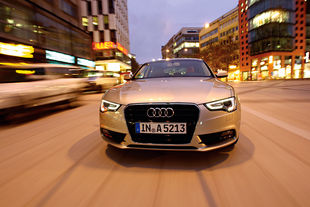
Audi A5 Sportback 1.8 TFSI
LATEST CAR NEWS - Model maintained the Audi occurs A5 Sportback before the audience. The stylistic refinement appears less remarkable than the refreshed base gasoline engine 1.8 TFSI with 170 HP. 

Nice that there are still things you can rely on. The model refinement for example, gladly facelift called, is always due if a model has achieved half of its planned life cycle so the Audi's Sportback now A5 the turn.With unsightly cars, the FA saves nothing more, at recognized well-built the designers well do to change anything Existenzielles to the original design. 

The Audi A5 Sportback they all properly made. He was already on the debut of the Coupé in 2007 as one of the most beautiful models that Audi has ever built, and filed seamlessly in the range of verantworteter by Walter de Silva, memorable forms. The face of the latest version, here in the four-door hatchback version of the Audi A5 Sportback, was accordingly only mildly lifted. So mild even, that only the experts immediately recognizes the differences and the poets of the associated press text must abundant artificial stride through the Wortsalat. "Pronounced edges highlight the sculptural look of the hood", it is called da.Or: "big air intakes, inside pointed constantly to be powerful edges framed." Thank you. That is enough. 

First-class workmanship and effortless operation 
As applicant or buyer you must not bend on the other hand, to this Audi A5 Sportback great to find. Not only because of its beautiful figure, but above all because of his inner values: first-class workmanship, high-class interior and effortless operation. Where not only easy to learn navigation through the on screen menu is meant, but the essential operating activities while driving by the hand go the playful ease with. 

The new electromechanical steering ensures with its direct translation an excellent contact with the road, the six corridors of the circuit flutschen casual gentle pressure from your wrist in the streets. The Audi A5 Sportback requires no concentration 1.8 TFSI itself, which can save themselves the driver for more important things 

Stress-free driving high comfort in the Audi contributes to A5 Sportback. There were Audi has always been good, comfortable seats, but the response capacity of the suspension was long not just as a domain of Ingolstädter. Because a role may have played on the one hand, that you like to look as a dynamic competitor of a further Bavarian brand, it is but also a matter of the technical concept. Very far forward in the bow of the Audi A5 Sportback built-in mass makes it difficult to find a harmonious balance between suspension and damping on the front axle. Since Audi the axis has moved forward a few inches, the conditions have become somewhat better. The typical Stuckern on Querfugen but is not disappeared, appears but not penetrating. 

Sport mode of the Audi A5 Sportback shaking through 
Generally the suspension of the Audi works A5 Sportback pleasantly supple when comfort is selected in the additional subject requirements and existing in the test car Adaptive damping control in the mode. Then, the demanding price range fit response and swallowing ability. The sport shock set-up should only choose who considers it the highest level of driving dynamics, where the bones be shaken properly. 

To the facelift of the Audi A5 Sportback is also an evolved petrol engine, the ten horsepower has increased. He is a perfect example, where currently is the journey into engine development: to less cubic capacity and charging. As to the standard consumption and thus tax-related CO2 emissions, especially in the new European driving cycle, in which be determined, achieve particularly favourable values. 

Under the bonnet of the Audi A5 Sportback 1.8 TFSI sits so a relatively dainty dimensioned four cylinder, Audi relies on the now commonly used trick to disguise the true dimensions of Hubvolumens in the name of the model. Only TFSI stands on the rear, as an indication of turbocharger (T) and gasoline direct injection (FSI). Engine capacity 1.8 litres at work are just, but modern technology, this shows clearly in this case is such as to throw valid ideas on board for decades. Because what the four frail Pistons in the Audi A5 Sportback 1.8 TFSI do bring, has quite fed up with the character of an engine with displacement. That the maximum power is already achieved at 3,800 rpm, is one of the advantages of Turbo technology. 

The chunky description of the Audi A5 Sportback 1.8 TFSI also contributes to, that it was possible to teach a running the Turbo unit, that distinction is hardly of a teat. Delayed response, little power at lower revs, but this foaming over temperament under full load at high speeds - all this once little positive effects of artificial ventilation belong to the past. The Audi four cylinder is clean at the gas, appears to already in the area just over 1,000 rpm powerful and shows a corpulent power delivery with the throttle fully open. 

Audi A5 Sportback 1.8 TFSI engine noise well contained
Feels that it is absolutely fully motorized, the refinement of the Audi contributes to 1.8 TFSI A5 Sportback. Of course a cylinder will never develop the silky softness of a cylinder, but the murmur is so well insulated that it accepts no annoying volume even with a heavy Gasfuss. Who is on the go very fast on the highway, will find it rather annoying, that succeeded not Audi despite the well-known diligence in the body construction, not to prevent the set of the wind on the frameless side Windows. 

Fast riders may of course say goodbye by the values of the standard consumption. Between ten and eleven litres are used in appropriate manner with the Audi A5 Sportback 1.8 TFSI quickly together. But who cares a conscious economic driving style and heed the instructions of the gear indicator on the dashboard, lowers the usage without serious concessions to the driving dynamics at values in the eight litre range, so the combo of little engine capacity plus boot proves to be highly efficient.
A car with a high satisfaction score thus, when also on critical inspection nothing serious to suspend it provides. The rating agency of auto is therefore also not petty motor und sport. The Audi A5 Sportback 1.8 TFSI gets five stars.LATEST CAR NEWS
0
Land Rover Expedition DC100 Concept
LATEST CAR NEWS - Car manufacturer Land Rover back presenting interesting sights to show off a new look from DC100 Concept. The model of this Expedition will be featured at the New York Auto Show at once marked the anniversary of the brand Land Rover 25th in the land of Uncle Sam.

Reported by Worldcarfans, SUVs That do Inaugural its debut at the Frankfurt Motor Show last year was is predicted to be the successor generation of Land Rover Defender 2015 models. This model would later be featured in other exhibitions with different automotive colors.

Land Rover Expedition was prepared for DC100 Became the successor generation of off-road vehicles and will be the appeal of consumers in the land of Uncle Sam.

This adds a cool look of an SUV with a nice wrap of orange color white chime. In Addition, the snowflake and tires off road all-terrain was adopted for conquest. Roof rack with integrated water snorkel complements the grandeur of DC100 Expedition. (LATEST CAR NEWS)
0
Porsche Cayenne Diesel
LATEST CAR NEWS - Porsche Cayenne presents them in the United States at the New York Motor Show 2012. Later, a variant with a segment of the Sport Utility Vehicle (SUV) will also fill in the U.S. automotive market.

Porsche pinned diesel V6 with a capacity of 3.0 liters, Cayenne's engine under the hood. Porsche chose the diesel engine to catch fuel efficiency, at a time when more and more soaring oil prices.

Porsche Cayenne Diesel is capable of unleashing the power of 240 horsepower and torque of 406 lb. ft. at 1750 rpm spin machine. With this engine, the car was able to penetrate forbidding acceleration 0 to 100 km/h in 7.2 seconds. While reaching a top speed of 135 mph or 220 km/h.

Further, in terms of interior also did not experience significant changes. It just happens to additions to the instrument panel and a panel of entertainment such as Bluetooth connectivity, audio with sound quality as well as the shape of the wider designed cabin.

In addition to the variants of the Cayenne, car manufacturer from Germany is also showing a variant of the Porsche Boxster and Porsche 911 Carrera Cabriolet at the New York Motor Show 2012. (LATEST CAR NEWS)
0


Nissan Motor Co. Chief Executive Officer Carlos Ghosn said electric cars will make up at least 10 percent of global vehicle demand by 2020, depending on conditions.

“Ten percent by 2020 is very reasonable,” Ghosn said, referring to research by Massachusetts Institute of Technology. Demand estimates are based on Nissan’s assessment of rising energy prices and tougher environmental regulations, Ghosn said at a news conference today after the opening of the automaker’s new headquarters in Yokohama, south of Tokyo.

Nissan, Japan’s third-largest carmaker, today unveiled an electric car able to travel 100 miles (160 kilometers) on a full charge, saying it plans to start sales in the U.S., Europe and Japan next year. Nissan spent 17 years developing the car’s lithium-ion battery, which it expects to help make the automaker the biggest supplier of electric vehicles.

“It’s an aggressive number but I think it’s achievable as the number of eco-conscious people will grow,” said Yasuhiro Matsumoto, senior analyst at Shinsei Securities Co. Ghosn gave that forecast partly to urge governments, manufacturers and his company’s partners to cooperate in promoting electric cars, Matsumoto added.

The price of the five-passenger electric Leaf will be “competitive,” Ghosn said at the unveiling. Excluding battery, it will cost about the same as an equivalent gasoline-powered car, he said.

‘Mass Market’

“We are going to go for mass market,” Ghosn said. “The car will be reasonable for consumers with zero emissions, and that is just a cherry on the cake.”

The compact Leaf is modified from the platform used for Nissan’s Tiida hatchback, sold in the U.S. as the Versa.

The car’s lithium-ion battery pack can be fully recharged at a 200-volt outlet in eight hours, or in less than 30 minutes from a so-called fast-charge station, according to Nissan. The automaker is preparing to produce about 350,000 electric vehicles a year globally.

Nissan aims to use a $1.6 billion U.S. loan to retool a factory in Tennessee so battery-powered cars can be made on the same line that currently produces hybrids and other models. The automaker will also receive grants and loans from the U.K. and Portugal to build factories for lithium-ion batteries. The company hasn’t disclosed the amount of aid it will receive.

The Japanese automaker has said it will have the capacity to produce 200,000 electric vehicles in the U.S., 100,000 in Europe and 50,000 in Japan. Nissan and partner Renault SA plan to offer electric vehicles in the U.S. and Japan starting in 2010 and globally in 2012.

Hybrids

Automakers have begun to develop gasoline-electric hybrid models as higher fuel prices and rising environmental concerns spur demand. Toyota’s Prius hybrid was the best-selling vehicle in Japan last month, while Honda’s Insight ranked fourth, excluding minicars.

Ghosn has said Nissan didn’t have the financial resources to develop gasoline-electric hybrid technology in the late 1990’s. The automaker is planning to deploy electric powertrains in compact cars and hybrids for bigger and luxury models.

Nissan aims to sell a hybrid car using its own system in fiscal 2010 in Japan and the U.S. Currently, the automaker’s sole hybrid, the Altima, uses Toyota technology and is only available in the U.S.

0


Toyota's third generation Prius has proved so popular that the cars battery supplier, Panasonic simply can’t match demand and as a result customer waiting lists now extend up to 10 months world wide.

Yesterday at the company's quarterly earnings announcement Takahiko Ijichi, Toyota senior managing director, said "Unfortunately, the batteries are not catching up with demand. Production of the batteries needs to be increased in order for our production to go up."

Toyota has production capacity to build 500,000 Prius hybrids per year, which Panasonic EV Energy can supply, but with booming demand for the new Prius, Toyota is hampered by the inability of the battery supplier to quickly increase production.

Last summer Toyota said it would begin to build the Prius at its Tupelo, Miss., factory in late 2010, but that plan is currently on indefinite hold. Ijichi says Toyota won't invest to expand Prius production until it is assured of an adequate battery supply.

Panasonic believes it will be able to match demand in a few months as it doubles EV battery production capacity to one million batteries per year by 2010.

0


Nissan and Europcar – the European leader in passenger car vehicle rentals – are forming a partnership to market electric vehicles by 2010. This partnership will see electric vehicles available for rental in France, Germany, Belgium, Spain, Italy, Portugal, the United Kingdom, Australia and New Zealand and will be subsequently extended to other countries. Electric vehicles rentals allow extended test drive as a way to introduce drivers to the benefits of EV motoring.

The Renault-Nissan Alliance has already formed partnerships with 27 governments, cities and other organizations to advance the deployment of EVs worldwide. Renault-Nissan electric vehicles will be introduced in the United States and Japan starting from 2010 and will start mass-marketing electric vehicles globally in 2012.

To date the Alliance has signed two final agreements in Europe with Portugal and the Principality of Monaco. The two agreements formulate concrete proposals - ranging from incentives and infrastructures to education pro grammes – creating the right conditions for mass availability and acceptance of electric vehicles. Further EV initiatives have begun in Kanagawa Prefecture and Yokohama in Japan, as well as in Israel, Denmark, Portugal, Monaco, UK, France, Switzerland, Ireland, Hong Kong, Singapore, and China.
In the United States, the Alliance is working on Electric Vehicles infrastructure in Tennessee, Oregon, Sonoma County and San Diego in California, Tucson and Phoenix in Arizona, Seattle in Washington, and Raleigh, North Carolina.

0


The promise of wireless electricity has been around for over 100 years. Nikola Tesla spent much of his productive life experimenting with wireless power, the familiar Tesla coils is actually a resonant wirelessly power transmitter, and the dream of wireless power was also his undoing when his Wardenclyffe project was terminated in 1904. Over the following decades very little research has been conducted with the prominent acceptation of Bill Brown who’s experiments in microwave wireless power transmission culminated in a successful demonstration in 1975 by transmitting 30kw over 1 mile at 82.5% efficiency at the Goldstone Deep Space Communication Complex.

Wireless power research was dormant again unit 2007 when an MIT scientist demonstrated wireless powering of a 60W light bulb with 40% efficiency at a 2m (7ft) distance using two 60cm-diameter coils. In 2008 Intel reproduced the MIT group's experiment by wirelessly powering a light bulb with 75% efficiency at a shorter distance.

Now at this years Consumer Electronics Show in Las Vegas half a dozen companies are demonstrating wireless power products that will be on sale as early as April this year to recharge your laptop, iphone or power tools. Some of those products promise to render extension cords, cigarette lighter plugs, 8 plug powerboards and multiple chargers a thing of the past.

There are several different wireless electricity technologies on offer

1. Inductive Coupling

They look like a mouse pad and can send power through the air, over a distance of up to a few inches. A powered coil inside that pad creates a magnetic field, which much like a conventional transformer, induces current to flow through a small secondary coil that's built into any portable device.

A Company called Powermat has designed a pad which can charge up to 6 different enabled electronic devices. Powermat's inductive technology pairs an ultra-thin mat (5 models to choose from) with a variety of receivers, which connect to your favorite electronic devices. Future applications could be embedded directly into tabletops or other surfaces. The system even allows for the wireless transmission of data - audio & video - allowing users to sync their iPods or transmit video to their TVs at very efficient transfer rates.

Another company Fulton Innovation who are exhibiting at the show, with their partners - Texas Instruments, Energizer, Leggett & Platt and Bosch Power Tools - will feature over a dozen new applications and products that will demonstrate wireless power in the home, office, garage, and beyond. Their eCoupled technology eliminates the need for power cords by creating an electromagnetic conduit combined with an intelligent control system that constantly monitors the power flow to insure optimal efficiency and safety.

ECoupled uses a wireless powering technique called "close proximity coupling," which uses circuit boards and coils to communicate and transmit energy using magnetic fields. The technology is efficient but only works at close ranges. Typically, the coils must be bigger than the distance the energy needs to travel. What it lacks in distance, it makes up in intelligence. In conjunction with the Wireless Power Consortium, Fulton, a subsidiary of Amway, has developed a standard that can send digital messages back and forth using the same magnetic field used to power devices. These messages are used to distinguish devices that can and can't be charged wirelessly, and to relay information like power requirements or how much battery is left in a device.

One of Fulton partners Bosch has designed wireless chargers into battery power tool carry cases while Leggett & Platt have designed a center consule for vehciles that can inductively charge flash lights and cell phones. The charging surfaces come in three power levels: low is for devices less than 5 watts, medium can handle 100 watt charging, and high power charging surfaces can produce kilowatts. These charging surfaces are harmless to touch, and a Leggett and Platt representative assured us there were no dangerous radiation levels.

Texas Instruments announced last November that it would manufacture a chip-set that will reduce the manufacturing cost of integrating eCoupled wireless power into consumer electronic devices. Devices now in the pipeline at companies such as Bosch, Energizer, and others will look just like their conventional ancestors. Companies such as Philips Electronics, Olympus, and Logitech will create a standard for products, from flashlights to drills to cell phones to TV remotes, by the end of this year.

Wipower demonstrate 5 light bulbs powered using inductive coupling with 74% efficiency which they say compares favourably to the median efficiency of 58% found in many corded power supplies today, (a PC power supply typically is 70-75% efficiency). The WiPower Surface is designed like a tablet on top of which devices can be placed for charging. The Surface is typically a standalone unit but, later versions are expected to be integrated into desks and other furnishings. On the other side, the receiver is retrofitted to, or integrated with, the device intended to be charged. When devices with a receiver are placed in any position or orientation atop a transmitter, they will charge as if it were connected to a conventional power supply. Their technology and products are based on a modified coreless inductive technology architecture.

2. Radio-frequency Harvesting

PowerCast offer a wireless electricity technology based on what's known as radio frequency, or RF. This can transmit power across distances of up to 85 feet. A transmitter plugs into the wall, and a dime-size receiver (the real innovation, costing about $5 to make) can be embedded into any low-voltage device. The Powercast demonstration transmits 3 watts at 900Mhz through a patch antenna that is received by several LED equipped rectenna, which is a simple dipole antenna with a Schottky diode at the feedpoint that converts radio waves into direct current. Powercast and its first major partner, electronics giant Philips, are set to launch their first device powered by electricity broadcast through the air.

3. Laser

PowerBeam showcases wireless lamps and picture frames. Located in Sunnyvale, Calif., the company uses yet another wireless-powering approach. Its technology beams optical energy into photovoltaic cells using laser diodes. Although the company says it can maintain a constant energy flow across long distances, the difficultly of targeting a laser means that it's not ideal for charging moving devices.

Their laser can currently generate about 1.5 watts of power to solar cell 10 metres away. This would be enough to power an electronic speaker or small LED (light-emitting diode) lights, but not enough to operate a laptop, which requires an estimated 30 to 50 watts. However, the company claims that the technology could comfortably be scaled up.

4. Conductive Pad

Boulder, Colo.-based WildCharge is demonstrating a mat that uses a conductive powering technique. This is more efficient than inductive powering but requires direct contact between the devices and the charging pad. Though most of the mats or pads on display are intended to power only a handful of devices at a time, WildCharge says the product design is certified for up to 150 watts--enough to power 30 laptops.

5. Magnetically Coupled Resonance

Another wireless power technology is on display in a private suite high in the Venetian hotel tower. Magnetically Coupled Resonance was demonstrated in 2007 when an MIT scientist demonstrated wireless powering of a 60W light bulb with 40% efficiency at a 2m (7ft) and has been dubbed WiTricity. As proof that it works, an LCD TV is powered by a coil hidden behind an oil painting located 5 feet away. Another demonstration involves walking in the direction of another coil with an iPod Touch in your hand, it starts to charge when it gets within two meters.

The technique can power an entire room, assuming the room is filled with enabled devices. Though WiTricity uses two coils, just like the eCoupled system, it differs in that the coils don't have to be close to each other to transfer energy. Instead, they depend on so-called magnetic resonance. WiTricity doesn't depend on line-of-sight. A powered coil in your basement could power the rest of the house, wirelessly.

Electric Vehicle charging

These wireless electricity products represent an entirely new product sector and although it’s very early days and the varied technologies have yet to find their most appropriate niche (heres hoping a long drawn out battle over mobile phone wireless charging standards is avoided) the industry certainly has enormous potential. For example, the Mitsubishi MiEV Sport shown at the 2007 Tokyo motor show presented the idea of wireless battery charging for Electric Vehicles via a microwave system where the receiving antenna was located on the rear bumper next to the license plate. Inductive coupling would also work well in this application so perhaps we might see a network of induction coils buried in the road (much like traffic lights have induction coils in the road surface as vehicle sensors) and parking spaces. As with some of the above systems that can communicate, much like a toll tag, this could facilitate intelligent opportunity recharging of EVs without any input required from the driver.

0


Nissan Motor Co. showed off its super-quiet, zero-emission electric car Monday — a key offering for Japan's No. 3 automaker.

The prototype is based on Nissan's Tiida car (Versa in North America), has room for 4 people and a top speed of just over 140kph. The Ev has a 80 kW / 280 Nm BLDC electric motor with a regenerative brake system that recharges the battery during deceleration and braking. This helps the car achieve a range of just under 100 miles on a full charge. That covers the typical daily distance driven by 98 percent of Japanese and British motorists, 95 percent of German drivers, 90 percent of those in France and about 80 percent of the average daily distance in the U.S. and China.

"Nissan will be a leader in zero-emission vehicles," Chief Operating Officer Toshiyuki Shiga said ahead of a test-drive event at the automaker's facility. "EV is the answer." Sales of Nissan's electric vehicle is scheduled to begin next year. Nissan says it plans to mass produce zero-emission cars globally from 2012.

A 24 kWh laminated compact lithium ion battery pack sits under the car's floor without compromising cabin or cargo space. The battery layout allows smooth underfloor air flow which helps reduce drag. A quick charge station, connected to a 3-phase 400 volt supply, can recharge the car in just 30 minutes and Nissan envisages these will be built around towns as part of a wider infrastructure to support electric vehicles. In the test car sockets for both home charging and quick charging are hidden under the Nissan badge at the front of the car.


When the car is plugged in there is a timer function which allows users to pre-set the air-con to come on at a set time and cool the cabin to a set temperature. As a result, the car is cooled using mains power, so the battery doesn't have to be used. The timer can also be used to set the battery charging at a specified time at night to benefit from more favourable electricity rates.

The company is also experimenting with wireless charging system that uses induction between a charging plate on the street and one on the bottom of the car. The prototype EV doesn't have this system but Nissan demonstrated it on another car. The system charges the battery when the two plates are aligned so Nissan envisages these to be installed in parking bays.

Nissan's electric vehicle has a function within it's in-dash GPS navigation system that shows the driving radius within range of the car's current level of charge, to reassure drivers who suffer 'range anxiety'. It can also calculate if the vehicle is within range of a selected on-map destination.

Nissan will unveil the electric car's exterior design at the companies new Yokohama headquarters Aug. 2. Stay tuned!

0


Hyundai Motor Group, the world's No.5 automaker, says it will invest $3.3 Billion in green projects to meet the government's stricter fuel efficiency and emission requirements.

Hyundai, which includes the country's two largest car makers -- Hyundai Motor Co and Kia Motors Corp -- plans to spend $3.3 Billion to develop environmentally friendly cars and reduce carbon dioxide emissions by 2013.

Of the total, $1.7 Billion will go to developing hybrid cars and $1.1 Billion to improving the fuel efficiency of engines. The remainder will be spent on energy facilities to cut emissions. Hyundai's announcement came after Samsung Electronics Co Ltd earlier this week unveiled a plan to invest $4.3 Billion in green research and development and facilities.

Over the next five years South Korea will invest 860 Billion, or 2 percent of its annual gross domestic product (GDP), in environment-related sectors, the government said in early July.

As part of the plans the government said it would require automakers to follow fuel efficiency and green gas emission rules above U.S. standards.

The government also said separately it would raise $1.6 Billion for "green industries" from the private sector.

HSBC estimates that of Asian government's stimulus packages in response to the recent credit crunch, spending on green-related investments will account for 20 percent, or $272 billion, more than double the amount earmarked for green projects in the Americas and five times bigger than Europe's.

0
Marussia B2
LATEST CAR NEWS - Blessing of activities such as the Geneva Motor Show, we have a chance to see a very eccentric sports car Marussia B2. Marussia is a Russian sports car manufacturer founded in 2007.

Marussia B2 is an evolution of the Marussia B1 was first shown at the Frankfurt Motor Show 2009. These two penympang vehicle only weighs 1100 kg and is offered in three engine options that will be planted in the middle of the car.

The choice of engine is naturally aspirated 3.5-liter V6-powered 300 hp or a 2.8 liter turbocharged V6 engine supplied by Cosworth are available in two options outut: 360 hp and 420 hp.

Before delivery to the rear wheels, engine power is transferred to the 6-speed automatic transmission. And about his ability? Marussia B2 is equipped with powerful 420 hp engine can accelerate from 0 -100 km / h within 3.8 seconds with a maximum speed over 250 km / h.

Car Feeds

Blog Archive